
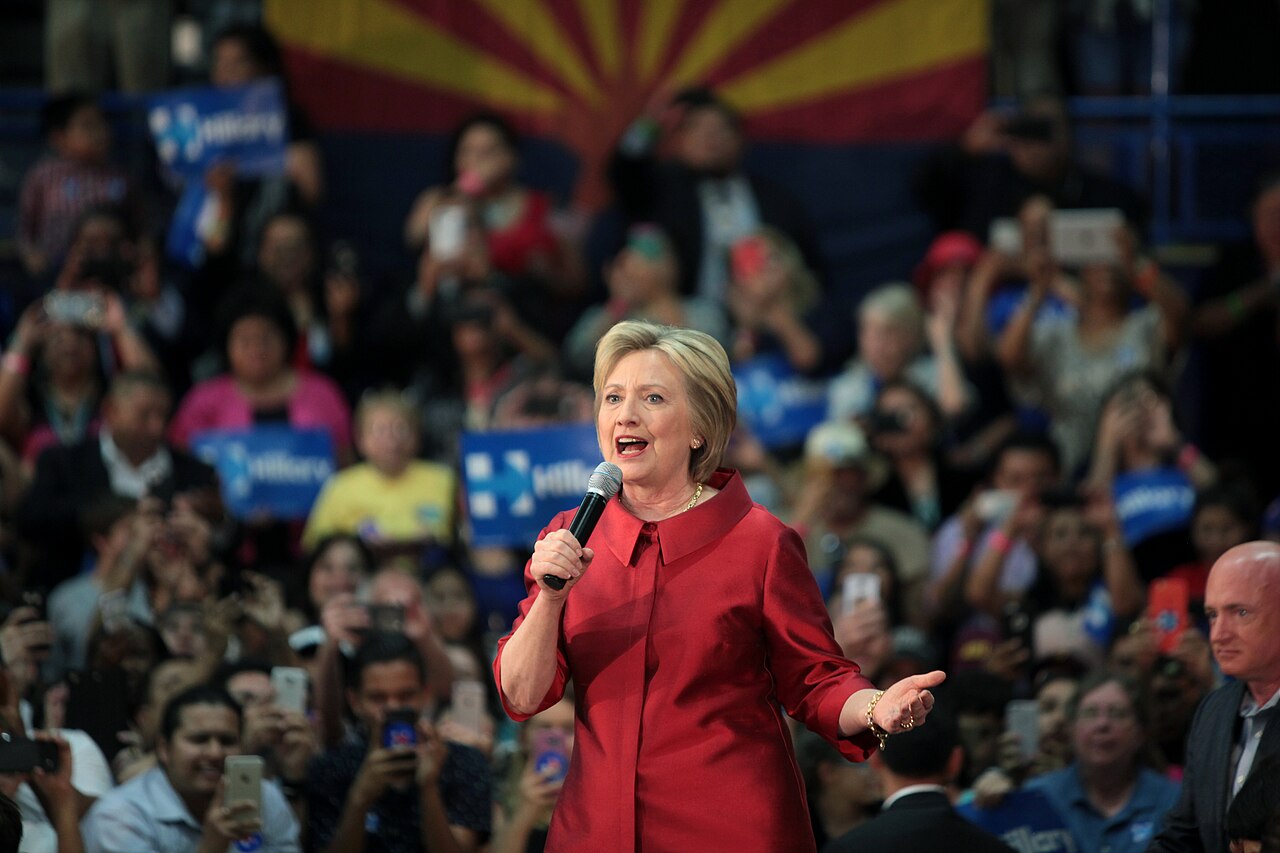
Hillary Clinton has a brand-new scandal to peddle, and she already stuck a cutesy “-gate” nickname on it.
Not long ago, she sounded like Jensen Huang’s defense attorney.
But once Donald Trump helped put Huang back at Nvidia, she flipped, and the real fight isn’t about romance.
Clinton’s Supergate Hysterics
Nvidia’s board reinstated Huang as CEO after he resigned over reports of an extramarital relationship with Alice Huang. She is a former Megaspeed executive whom US intelligence reportedly identified as a suspected Chinese intelligence asset.
President Trump didn’t hide his role. He told CNBC he stepped in to get Huang his job back.
“I believe my intervention was very important,” Trump said.
A source familiar with the effort told Fox News that Trump and Vice President JD Vance got security briefings first and came away convinced Huang posed no national security threat as CEO. According to the source, Vance then worked with Silicon Valley figures and Nvidia’s leadership to push the board.
Clinton answered on X. “Is it a national security scandal? Yes. Is it a corruption scandal? Yes. Is it an insider trading scandal? Yes. Is it a market manipulation scandal? Yes. If it’s ‘super intelligence,’ call it Supergate,” she wrote.
And on The View, Sunny Hostin read the post aloud like a sermon.
“She’s never been wrong, and this is just what it is,” Hostin said.
Hostin apparently slept through election night 2016.
She also claimed Trump made “approximately $15 million” when Huang returned, and Nvidia’s stock rose. The Financial Times report behind that talking point said only that the President could have made up to that amount. “Could have” is carrying a lot of weight there.
Clinton Sang a Different Tune on Her Podcast
Here’s the part the ladies of The View left out.
Before Huang’s reinstatement, Clinton took up his cause on her podcast, High Stakes with HRC, which she co-hosts with Kara Swisher. According to Wccftech, she argued that intelligence officials owed Huang a defensive briefing if they believed a foreign “honeypot” operation had him in its sights.
“You owe it to him to tell him,” Clinton said.
In that version of the story, Huang was a victim of a sloppy bureaucracy that failed to warn him. Then Trump and Vance helped bring him back, and Clinton suddenly saw four different scandals.
Nothing about the affair changed between the podcast and the post. What changed was who went to bat for Huang, and why.
The Fox News report offered a clue. Its source said the administration viewed Huang’s support for open-source AI as a backstop against big AI companies building powerful capabilities behind closed doors. The source called that a rare position among AI executives.
Clinton’s post never says open source. It doesn’t have to.
Why Open-Source AI Scares the Censorship Crowd
Open-source and open-weight models let anyone download, run, and modify an AI system. No single company owns the off switch, and no federal agency can call one CEO and change what millions of Americans see.
Huang made that case for years. “Without open source, startups can’t thrive, university researchers can’t do research, you can’t teach AI, scientists can’t use AI,” he said in a December 2025 talk.
The Trump administration agreed. Trump revoked Joe Biden’s regulation-heavy AI executive order in 2025, and his AI Action Plan included a section titled “Encourage Open-Source and Open-Weight AI.” The plan states, “We need to ensure America has leading open models founded on American values.” Trump also signed an executive order barring the federal government from buying woke AI.
Closed AI works the other way. A few big companies sit at a few chokepoints, and Washington already knows how to squeeze chokepoints.
Mark Zuckerberg admitted as much in a 2024 letter to House Judiciary Chairman Jim Jordan. “In 2021, senior officials from the Biden administration, including the White House, repeatedly pressured our teams for months to censor certain COVID-19 content, including humor and satire, and expressed a lot of frustration with our teams when we didn’t agree,” Zuckerberg wrote.
But social media was the warm-up act. In 2024, Google’s Gemini turned out images of the Founding Fathers as people of color, and Google paused the tool after the backlash. A handful of engineers in Mountain View had decided what American history ought to look like.
And Clinton has said out loud what she wants from the people running these platforms. In a 2024 CNN interview, she called for repealing Section 230 and warned that if the platforms “don’t moderate and monitor the content, we lose total control.” In a separate 2024 cable interview, she floated civil or criminal charges against Americans who spread Russian propaganda.
Picture that crowd with a few closed AI companies to lean on. Every chatbot answer about the 2020 election, COVID lockdowns, the border, or the Founding Fathers would run through a handful of companies and the regulators breathing down their necks.
Democrats Are Already Drafting the Blueprints
Democrats take control of Congress in January, and their AI plans are already on paper.
US Senator Mark Warner (D-VA) teamed up with Senator Brian Schatz (D-HI) and Senator Andy Kim (D-NJ) on a bill that would set up an AI Safety Board inside the Commerce Department. Warner could also take the Senate Intelligence Committee gavel.
Representative Lori Trahan (D-MA) plans legislation that would require independent experts to test leading AI models against safety standards. New York Democrats are preparing what Bloomberg Law called the country’s toughest AI limits for 2027.
Senator Amy Klobuchar (D-MN) is the top Democrat in bipartisan Senate talks, alongside Senator Ted Cruz (R-TX), over a bill that would let the federal government block the release of the most advanced models. According to Reuters, Klobuchar said any deal must make developers work with government experts to verify and test their models.
Every one of these comes wrapped in the word “safety.” But a government that can approve or block a model can also decide what that model is allowed to say. And a kill switch outlives any one chairman, so a tool built under a friendly Senate will be sitting there for the next one.
Open-source AI breaks that setup. Nobody can recall a model that’s already running on a million hard drives.
None of this makes Huang a saint. His praise for Communist China’s open-source models, like Moonshot’s Kimi, deserves hard questions, and the Alice Huang allegations deserve a full airing. Beijing has called the spy claim “nothing but smears,” and Trump adviser David Sacks has said, “the spy narrative is collapsing.” But the fix for Chinese open models is more American ones, not a Washington-licensed cartel.
Clinton spent a podcast episode feeling sorry for Huang. Then he came back with the open-source movement in his corner and the White House on his side, and he became a four-alarm national security threat.
Call it whatever you like. Clinton already picked the name.
Sources:
Fox News, “‘The View’ host says Hillary Clinton has ‘never been wrong about anything,’ touts response to Nvidia story”
Wccftech, Hillary Clinton on High Stakes with HRC and Jensen Huang
MIT Technology Review, “The open-source movement wants Jensen Huang back”
The White House, “America’s AI Action Plan”
FedScoop, “Open-source AI could provide ‘geostrategic value,’ Trump AI plan says”
Associated Press via ADN, Zuckerberg letter to the House Judiciary Committee
CNBC, “Google pauses Gemini AI image generator after inaccuracies”
The National Desk, “Hillary Clinton warns ‘we lose total control’ without social media content moderation”
PYMNTS, “AI Safety Regulations Gain Momentum in Congress Ahead of Midterms”
CDO Magazine, “Democrats Prepare New AI Legislation Targeting Model Safety and Rapid Expansion”
Bloomberg Law, “New York Democrats Plan Country’s Toughest AI Limits in 2027”
The Next Web, reporting Reuters on Senate AI bill negotiations
Fortune, Jensen Huang on Chinese open-source models
Associated Press via Fox Carolina, Jensen Huang affair and Beijing response
The Free Press, Jensen Huang and Nvidia